Forced molt

The important things for this are limiting light exposure and lowering the protein in their diet. Khakis Campbells have been known to lay without a break for over a year. The feathers become worn and their physical health declines greatly.

Pen the ducks and Eliminate all light exposure. The first 24 hours withhold food & water. The following day give them water but no food. They will not be happy but remember that overlaying can be fatal. Day three start feeding oats or another feed that is below 10% protein. Feed them the low protein food and continue to keep them in the dark. By day 6 they should have stopped laying and their feathers should start dropping. Once they are no longer laying slowly increase the protein in their diet but don’t go over 14% until they are actively molting. At that point you can increase light exposure and protein content.

Reducing light exposure and protein in the diet is also helpful in treating a prolapse. Forcing a hen to stop laying allows her to heal more fully.

Spring Time with Drakes

As the days grow longer and the temperature rises your charming little boys will turn into unruly sex fiends. Male ducks lack any social graces and would honestly breed the garden hose if they could figure out how to mount it. Until they reach about 4 years of age and have protected their favorite females from predation you will wonder why you even keep any of them around.

I can not stress enough how important the ratio of males to females can be. Out of my current group I have 18 females and 2 drakes. The five year old has attracted several new mates who prefer his less aggressive and less frequent breeding. Elvis has survived a ridiculous number of close calls and has an incredible will to live. He also displays a wariness that is a valuable survival trait.

what I mean by a wariness is easily observed. Watch your drakes, which one is holding back from eating treats and chasing everyone else away so “his” ducks can eat unmolested? Which one of your drakes keeps watch and helps you put the ducks away at night? Which one is an active breeder without brutalizing females? We had a second Khaki drake who honestly conformed more to the standard than Elvis but AP Carter was unpopular with the ducks and extremely violent, even for a drake. Elvis was feisty but his quad was very tight knit and he took the brunt of a dog attack trying to protect his three ducks. His son Little Boy Blue is an equally protective drake who leads his hens into their house at night. He is three years younger than Elvis and more active in pursuing females to breed but he is fast and not overly violent.

I realize “overly violent” is subjective given that drakes will rip out most of the ducks’ neck feathers during the season. Honestly, if you spend time around your birds you will see their social hierarchy and that can inform your decision on who to keep. Definitely breed to standard but when all things are equal the less disruptive drake is the one to select.

Too many drakes? Be prepared to butcher if you haven’t lined up homes early in the season. As harsh as that sounds it will lead to a happier and healthier flock. If you are horribly opposed to culling the extra drakes then be prepared to have multiple pens and houses or find someone who doesn’t want eggs but wants ducks for their pond.

Purebred birds need to be selected fo meet their standard. Do not breed inferior birds. Yes, AP Carter was physically a better specimen but Elvis was from a better egg laying line and had other qualities that were redeeming. If he had had a disqualifying fault we would have been forced to make a different decision.

My feeling is also that drakes should be purebred. That way when someone asks you can truthfully say “she is half khaki Campbell. Her mother is a barnyard mix but the sire is a khaki.” If it quacks and lays eggs I will keep her but I prefer not to breed mixed drakes. Because I keep ducks for eggs I want my mixed birds to still be genetically predisposed to lay heavily. That means a reliable drake with a proven track record of high production daughters.

The ratio of one drake with multiple ducks also simplifies paternity issues. Two years ago I knew that every fertile egg was fertilized by Elvis. Wanda Jackson had a clutch? Those are all purebred Khakis. I will explain sex linked color at a later point but because Elvis is brown I know the sex of all of his offspring with our black mix Sabrina. Black ducklings are male and chocolate brown ducklings are female. I can sell the boys off as pets early on.

As far as Elvis’s purebred sons I have found people want a drake from a strong egg laying line that has been socialized around dogs, cats, chickens, and other ducks. They are handled as ducklings and run to humans for treats. I make them desirable primarily to avoid having to butcher them.

As more people start keeping ducks for eggs and as pets, disposition takes on added importance. A huge production facility has no interest in socializing their birds. People wanting ethically raised eggs desire that additional interface with the animals. A completely wild bird is no fun. A drake that trusts humans and doesn’t run in fear or hiss makes a better pet. One of Elvis’s sons went to a farm with a dozen khaki ducks in need of drake. The new owners reported that he helped tame the ducks because he wasn’t terrified of humans. They were absolutely delighted.

Elvis

The patriarch of our flock weighs in at less than 4 lbs and has an attitude to compensate. We bought Elvis along with three ducks after a bobcat attack at their first home. The other drake and one of the ducks didn’t survive the encounter and the woman didn’t want the cat returning. Two friends made the 60 mile drive to pick up the birds and returned with empty diaper boxes holding the khakis.

I learned that khakis can indeed fly upon opening the first box. Luckily they spotted our other birds and stayed in the yard. They hadn’t left their old house to eat or drink for the three days following the attack so they were a dehydrated and not entirely steady on their feet. The other drakes immediately attack Elvis who was too weak to defend himself. I scooped the little guy up and carried him inside for some “spa” time.

Spa time for our ducks consists of a half filled bath tub and greens tossed into the water. Elvis drank and ate up the greens. Before we got there he protested being carried and viciously bit my finger. Well, he tried.

A rehydrated and fed little drake returned to the yard and ended up being a holy terror his first Spring with us. He bred everyone by running faster than the ducks and the other drakes. He was annoying and arrogant. He also pulled far fewer feathers off of the females and when he wasn’t chasing the unwilling females he stood watch over the three ducks he had arrived with. When another drake went after his group he attacked the offending drake rather than piling on top of the duck.

Despite his awful behavior I actually liked the little guy. His second Winter with us a Husky puppy jumped our fence and Elvis threw himself in between the dog and Wanda Jackson. His injuries were severe but not life threatening. The one canine punctured his head in that magical dead zone where nothing resides. The puncture would to his throat stopped short of penetrating his esophagus. Our veterinarian just shook her head and cleaned him up.

And then he had an encounter with a hawk where he escaped. And he was mauled two more times by dogs. And now he is a six year old drake who is finally slowing down. Just this past March his all time favorite mate was killed by a red-tailed hawk. I was saddened by the loss of Wanda Jackson but devastated the next night watching Elvis run around the yard looking for her. He has recovered but I worry that some of the fight has left my feisty little man. We will see if he can produce a few more equally feisty and ridiculous daughters later this season. His viability is waning, next year his son Boy Blue will be the drake we rely on to fertilize eggs and Elvis will retire and officially be nothing more than a pet.

Barnyard Mixes I have loved

Mixed breed, mutt, unknown duck, what ever you call them these ducks have a mixed and sometimes unknown ancestry. Usually the term barnyard mix is applied to birds of completely unknown parentage or multiple generations of cross breeding. Our duck Kitty Wells came to us with a purported history of “Russian Giant” and Swedish. She is a large bird that lays rather roundish eggs. Princess Diana is half Khaki Campbell and her mother Sabrina is a runner Cayuga cross who lays a beautiful blue egg with a rather dark bloom. Diana’s half sister is Gizmo, half Kitty Wells and half Khaki Campbell. She is a prolific layer of eggs that are midway between her mother’s giant offerings and a Khaki Campbell.

There is no shame in owning mixed breed or barnyard mixes. I am a huge proponent of egg layers of all shapes and sizes. I also don’t believe in continually producing indiscriminate ducks. We had a runner go broody and nest in a predator filled zone. I also had an incubator that I was still learning to use. I threw her eggs in hoping it would work on my second attempt and I was rewarded with 3 odd mixed sisters. My wife started calling them Charlie’s Angels but Sabrina was the only one who kept her angel name. Kelly is still Leadbelcher, named after the shade of model paint that matched her down. Chris is Goldie, named for the gargoyle baby in the Sandman comics. Black Sabrina and Blue Leadbelcher are daughters of our only non brown drake at the time. Goldie is the daughter of Elvis or Sebastian. Her size indicates her father was our Buff drake and not our Khaki.

At this point I keep one or two purebred drakes so when Kitty and Sabrina go broody I know what to expect from the hatch.

I don’t lie about the cross breeds nor do I pretend they are anything fancy. At the end of the day a runner-khaki cross will lay lots of blue shelled eggs and that is a marketable product but they will not breed true. A “Labradoodle might be cute and desirable but it is not a distinct breed, it is a hybrid.

You are not creating a new breed in your backyard, you are having fun and dabbling.

I will also say that the advantage Elvis the Khaki Campbell’s cross bred daughters have over his purebred offspring is the simple fact they don’t suffer from ovarian cysts. While we are selectively breeding out the hereditary health issue in our khakis the process is slow. The cysts develop at 2 years of age so we won’t incubate eggs from the females until we feel they are clear of the syndrome. It is nice to have reliable layers that we can be certain will give us 4 solid years of production.

Note Bunny’s left leg. What could possibly be wrong with it?

Chocolate Bunny is a blue runner khaki Campbell mix born on our property. She is obviously a smaller bird who exhibits wonderful traits from both of her stock breeds. She lays beautiful blue eggs and lots of them.
Bunny woas running to keep up with the other birds but her left leg was obviously not working properly. On closer inspection it didn’t appear to be broken, it just wasn’t “right”. We took her in to Animal Clinic and in the process met the newest veterinarian at the practice. She was as taken aback at a duck patient as I was by a doctor who looked 16.

Upon examination she determined the leg wasn’t broken and requested that we consent to an x-ray. At this point I simply wanted an answer so I can determine if we could find a non surgical fix or if Bunny needed to be euthanized. I agreed and bunny was whisked away to imaging.

A short while later a pale young doctor and a cranky Chocolate Bunny reappear. The image is perfectly normal. Prior to imaging one of the older doctors was examining Bunny and in the course of her exam there was a very loud snap when she pulled on the leg. Loud enough that the technician told me about it a few months later in a private conversation.

Bunny was still hobbling but the angle had changed on her leg. We opted to pen her separately in a covered 3’x3′ (1 meter) pen and administer rimadyl for a few days. By day 3 I decided she was not going to recover and planned on taking her in for euthanasia the following morning.

On the morning of the fourth day I opened the door to her house and out she marched. She was walking upright and showing off her runner heritage.

And every drake in the yard was on her.

She spent 3 more days in our hospital enclosure and then returned to the general population where she has remained in good health for a several months now.

We assume she dislocated her hip running up a slick doorway into her house. We have improved the traction on the doorways and have avoided any further accidents.

Winter Water

Ducks love their water and will gleefully play in it at temperatures that make humans cringe. What can we do to keep their water liquid during a cold Northern Winter? Unlike chickens who can survive by drinking out of shallow self contained waterers that are easy to heat, ducks require a deep enough water source to dip their whole bill. Ducks need to clear their nostrils after eating and are generally happier and healthier if they can dunk their entire upper body while drinking.

The easiest solution for one or two birds is a large heated dog dish. Any more birds than that and you will spend the entire day refilling the dish. I bring the dish in at night and let it defrost in the bathtub over night. Clearing the mud and gunk out of it helps the dish operate more efficiently. Besides, the only thing ducks love more than clean water is the chance to make it filthy.

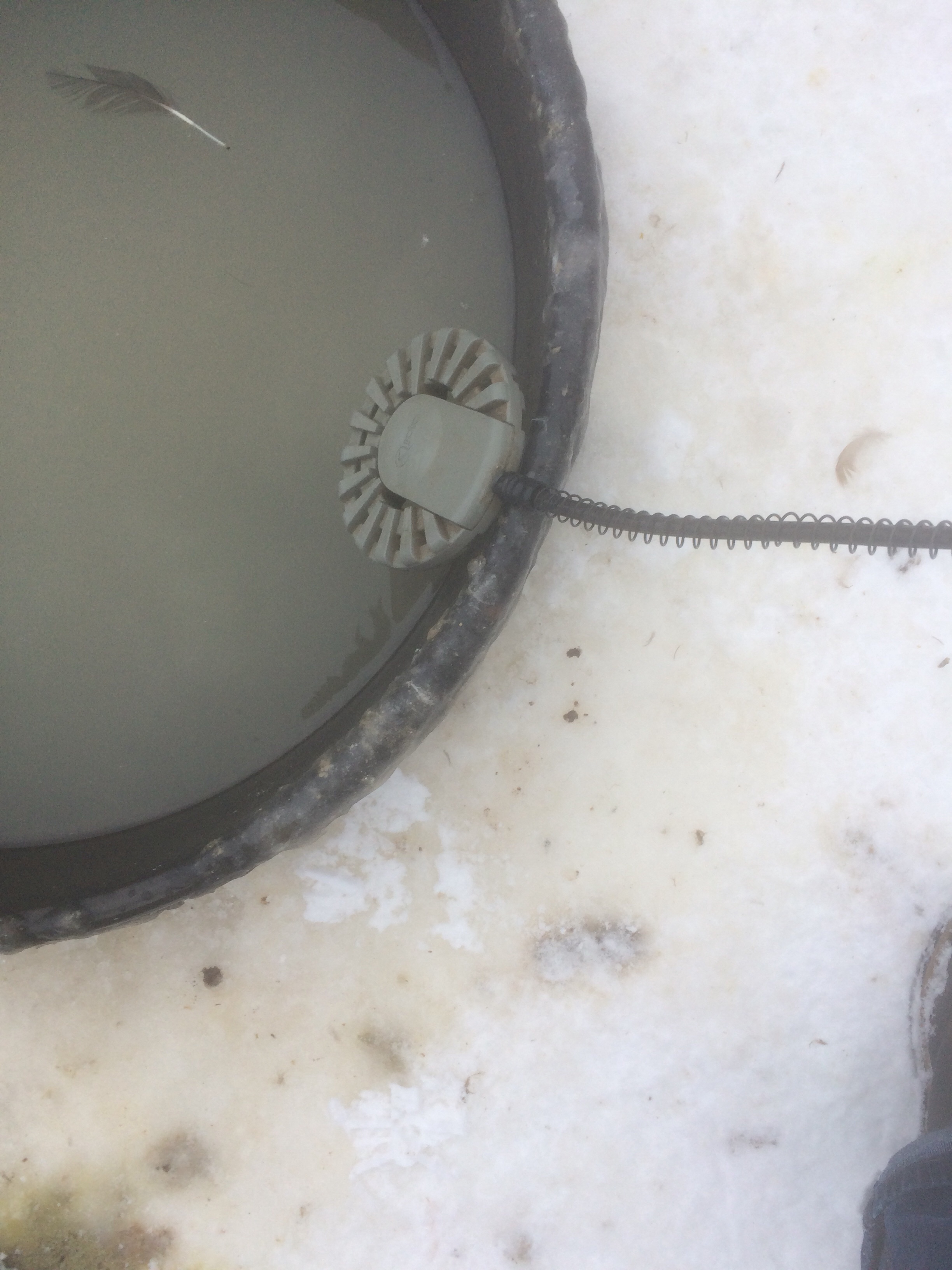
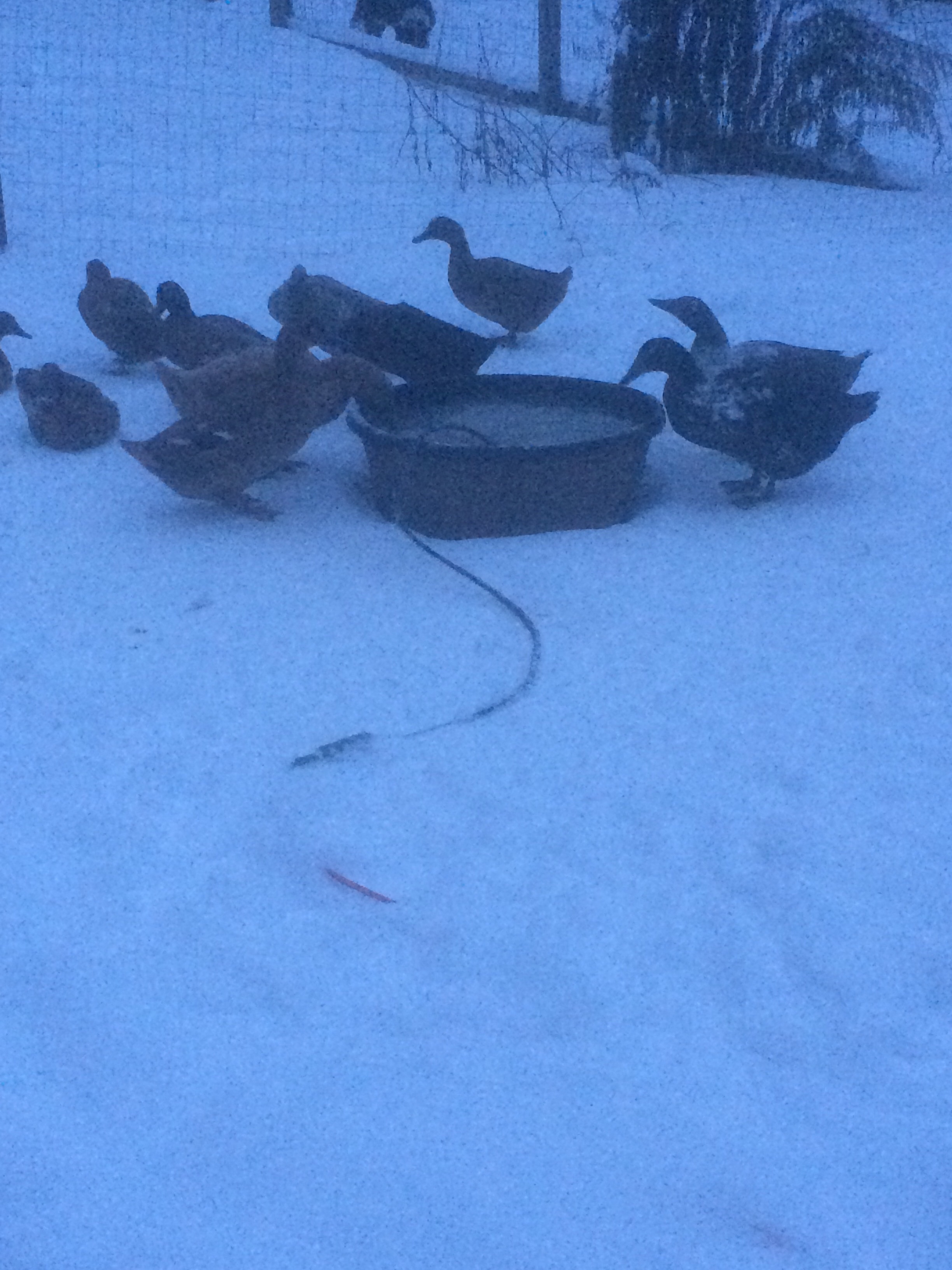
For more birds it is easier to use a rubber stock tank and a stock tank heater. There are various sizes and qualities of heaters on the market, your local feed store can give you advice on brands and price points. If you also have geese spend the extra money for a sturdier model. Geese will nibble (bite) on cords and pick apart cheaper models. Make sure you have a GFI outlet and if you are forced to run an extension cord buy a cover for the connection. I pull the cords out of the snow every time I check the water and make sure the cover is still over the connection. I also make sure it is outside of the duck splash zone and uphill from the tub. Common sense will prevent most accidents and accidents involving electricity can be fatal. I also make sure the heater itself is not covered in mud and duck debris, this will increase its effectiveness and lifespan. My preference for a rubber stock tank is connected to durability and the fact that if it freezes you can break the ice up and not destroy the tub.

If you choose to not heat the tubs or can’t access electricity in a pasture rubber stock tanks are your best friend. kicking the side to break up ice is possible without cracking the tub. they flex and forgive for a surprising number of years.